Most pattern work stays in the mind, but this is where we get into the body (which is where it needs to go if it’s actually going to change!). Grab a tennis ball and let’s go.
HOW
What your body is about to do
You get to experience four practices that you can do anywhere. There’s no need for equipment beyond a tennis ball, and you’ll quickly start shifting your nervous system from the inside out. The practices are simple enough to do in your living room and layered enough to keep you coming back.
RELATABLE PAIN POINTS
If you're in it right now
Most of us move through our day in the same 10 positions. Sitting at a desk, standing in a line, lying in bed, walking forward to wherever we’re going next. Our bodies are bored. Our bodies are trained and stagnant. The tension you carry, the stiffness, the low-level restlessness, a lot of that is your body asking for something to shift. This workshop gives it exactly that.
THIS IS HOW YOUR LIFE CAN CHANGE
What opens when you move
You feel absolutely liberated. You move your body in a direction it never goes and something you didn't know was wound tight just releases.
The permission you give your body to move without rules starts expanding into everything else. You speak up in a meeting you would have stayed quiet in. You take a different route. You make a different choice.
You walk backwards across your living room and your nervous system stops scanning for threats. Your shoulders drop. Your jaw unclenches. You didn't tell them to.
You shake your spine and feel emotions move through your body in seconds that have been sitting there for days.
You layer in the tapping and the words and your body starts holding new beliefs in a way that repeating them in your head never quite managed.
You finish the practice and the room looks the same but you feel like a different person standing in it because the rewiring has already started.
Walking backwards is one of Chris’ fave techniques because it fires neural pathways that forward movement never touches, which is exactly why Tiago starts here. Your brain has to wake up, your autopilot has to switch off, and your body starts receiving new information. Then he shows you how to break your habitual relationship with gravity, move stagnant energy out of your system fast, and movements that return you to the most natural human resting positions your body has been denied. His work returns you to the playful, raw, creative human you were born to be.
THIS COLLABORATOR BECAUSE
Why Tiago
He came to movement through gymnastics and circus performance and spent years working with some of the most serious movement practitioners in the world before building a school of his own. He doesn’t teach fitness. He teaches the body as a language, a tool for transformation, and a vehicle for everything you’re trying to shift.
WHAT YOU GET
What You Get
Shift Your Centre of Mass — A foundational practice to get you out of your habitual stance and into a fresh relationship with how your body moves through space.
Spine and Body Shake — A full body practice to release what's been sitting in your system. More powerful than it looks and immediately accessible.
Squat Development and Active Resting — Returning to one of the most natural human positions. This one changes how you move through your whole day.
Tennis Ball Playfulness and Awareness — A simple tool that opens up sensitivity and coordination in the body. This is where the practice starts to feel like play.
MEET YOUR TRAINER
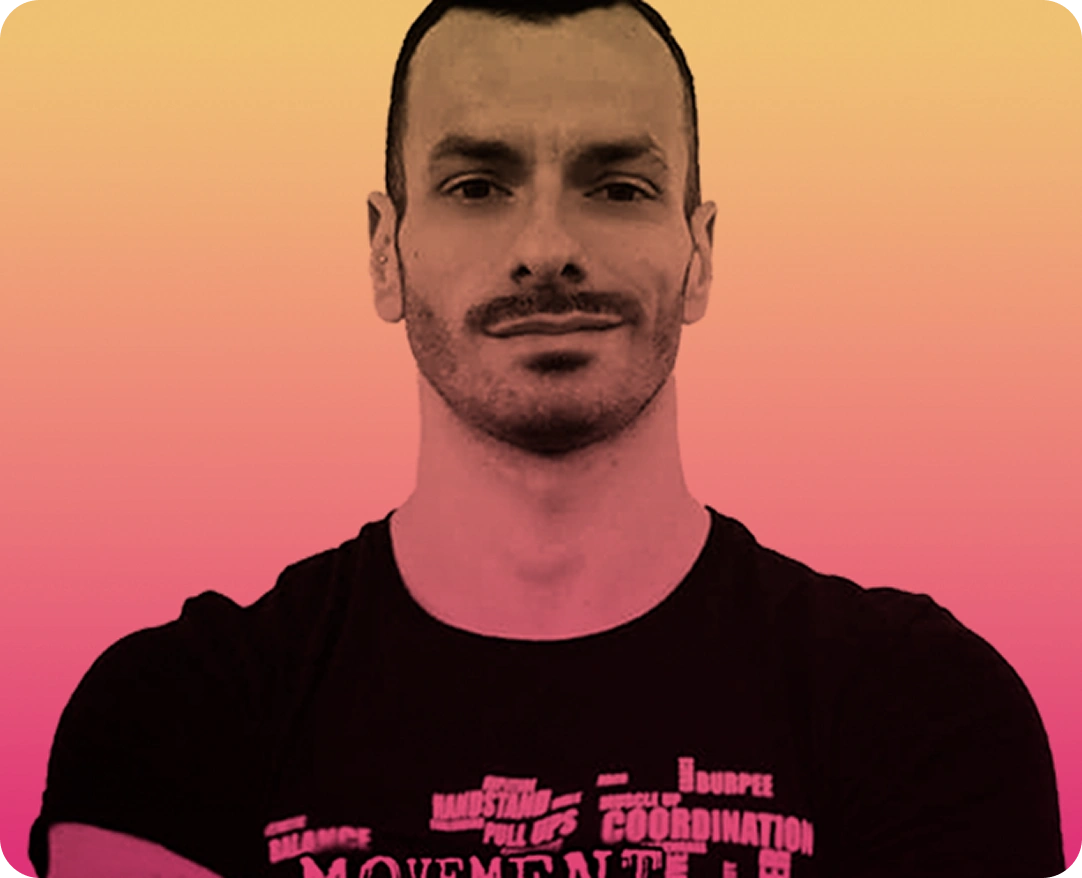
Meet Tiago
Tiago Martins started as a competitive gymnast, went on to perform as a circus artist and dancer across Portugal, London, the US, and China, and eventually co-founded Movement Lisboa in 2017, one of Portugal’s leading movement education spaces. He’s trained under some of the most respected names in contemporary movement culture including Ido Portal, and brings that depth to workshops that are genuinely accessible to anyone who has a body and a floor. His parents were fishermen and he grew up fascinated by octopuses, which tells you everything about how he sees movement: adaptive, multidirectional, and built for a world without walls.
Your body is craving more. It’s time to deliver. Let’s pivot.